What Is Customer Education? Definition, Benefits, and Best Practices


Customer education is the strategic process of teaching customers how to successfully use a product or service to achieve their desired outcomes. It covers onboarding, training, certification, and the ongoing resources that turn a purchase into the result the customer bought it for.
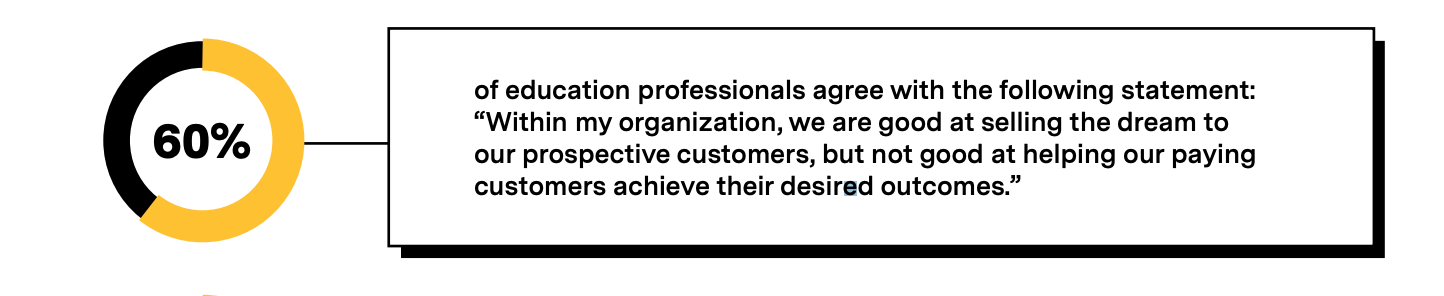
Intellum research surveying 445 workplace education professionals found that 60% agreed: "We are good at selling the dream to our prospective customers, but not good at helping our paying customers achieve their desired outcomes." That gap—between what a product promises and what a customer actually accomplishes—is where customer education lives. (For the specific obstacles that create this gap, see our breakdown of common customer education challenges.)
When customers don’t reach the outcomes they expected, they feel disappointed. Even strong products can fail if customers don’t know how to use them to their full potential.
That’s where customer education comes in.
Marketing content builds awareness and thought leadership builds credibility. Customer education drives behavior change, equipping customers with the knowledge and skills they need to get maximum value from what they've purchased.
Customer education helps customers learn how to use a product or service to reach real goals. When done well, customer education improves the customer experience, increases product adoption, and supports key business goals.
And the results are real.
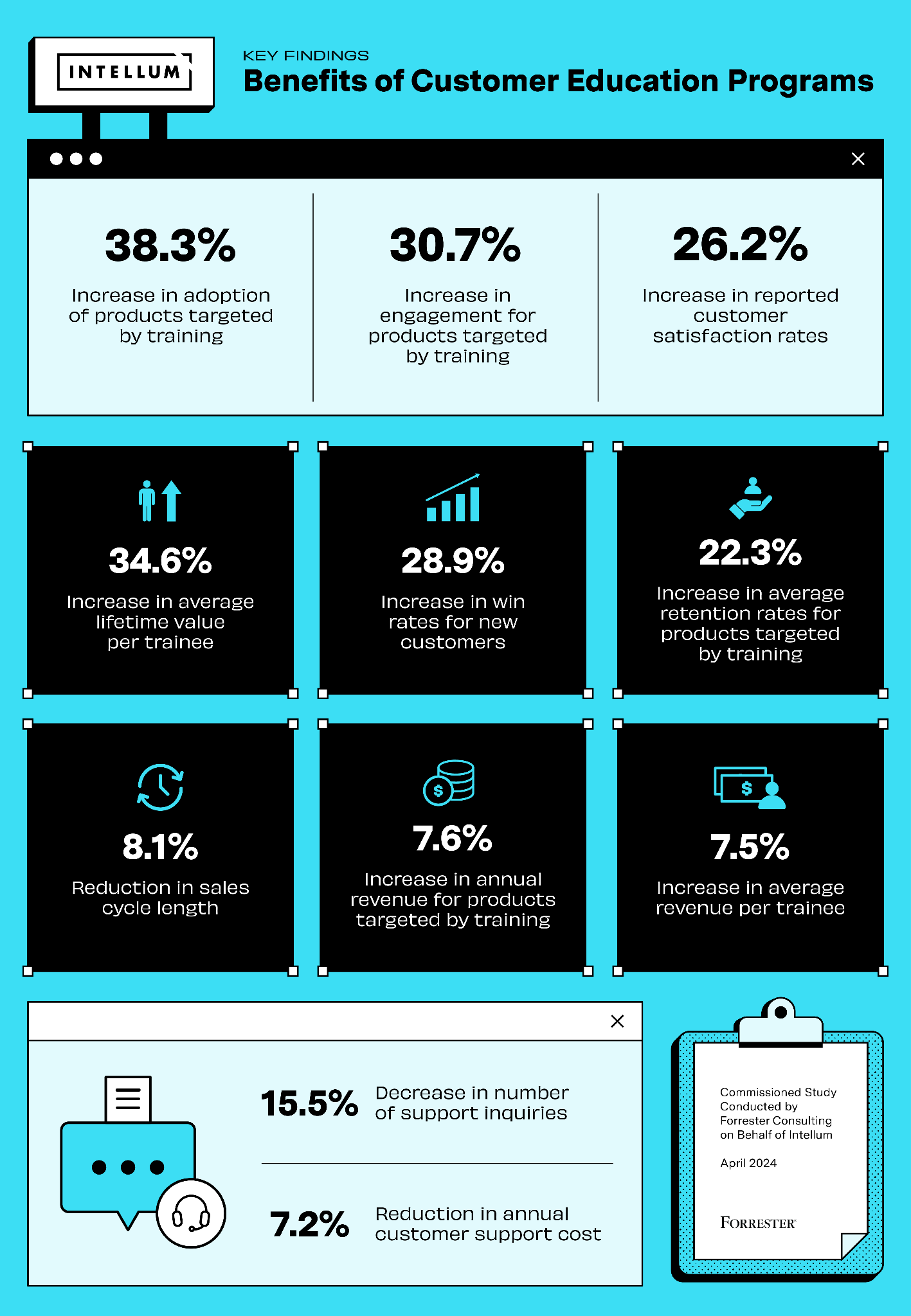
According to 2024 Forrester Research, customer education programs deliver strong returns:
- 96% have at least broken even on their education programs
- 86% report a positive return on investment
- 38.3% increase in adoption of products targeted by training
- 26.2% improvement in customer satisfaction
- 35% increase in average lifetime value per trainee
- 7.6% increase in revenue for products targeted by training
- 15.5% decrease in customer support costs for trained users
These numbers show a clear trend. When companies invest in education, customers use products more, stay longer, and need less help from the support team.
At Intellum, we help companies build customer education programs that deliver these results. We also know that teams new to customer education often have many questions.
This guide answers the most common ones:
- What is customer education?
- Who is customer education for?
- How do you launch a customer education program?
What is Customer Education?
Customer education is the process of teaching customers how to reach a specific outcome using a product or service.
Simply put, customer education helps customers turn what they buy into real value.
The mechanism is straightforward. A customer buys a product because they want a specific problem solved. Education is what closes the distance between the purchase and the outcome, teaching customers how the product fits their work, which features matter for their goals, and how to avoid the mistakes that create early frustration and churn. When customers reach their desired outcome, they stay, expand, and advocate. When they don't, they leave—regardless of how strong the product is.
Customer education doesn’t rely on random training. It uses a clear structure and purpose. Most programs include:
- Online learning, like courses and certifications
- Short videos, articles, and guides
- Self-paced lessons and instructor-led sessions
- Live training and on-demand content
Many companies deliver this content through a learning management system (LMS). The LMS connects education to the broader customer experience, including the knowledge base and support tools.
The main goal of customer education is not just teaching features. The real goal is to help customers succeed at scale while supporting business goals such as:
- Increased customer retention
- Improved customer satisfaction
- Higher product adoption and usage
- Reduced support costs
- Expansion revenue from existing customers
The Benefits of Customer Education
The benefits of customer education go far beyond training. When companies educate customers well, they see measurable changes across the entire customer journey. According to Intellum's 2026 Education-Led Growth Report, 81.6% of education programs now prioritize revenue as a core business outcome, reflecting how far the function has matured beyond basic onboarding and support deflection.
Here's what the data shows:
1. Higher product adoption
Customers can't use what they don't understand. Education removes confusion and helps customers get value faster. According to Forrester, education programs drive an average 38.3% increase in product adoption for trained products, meaning customers use products more often and more deeply.
At Qlik, a global leader in data analytics, product-focused education on Intellum drove completion rates from 8% to 23% and monthly active user engagement from 15% to 45%. Read the full story.
2. Better customer experience
Education makes the customer experience easier and smoother. Customers spend less time feeling stuck and more time making progress. When customers know where to find education content, they solve problems on their own using courses, videos, and the knowledge base — rather than waiting on the support team.
Forrester data shows a 26.2% improvement in customer satisfaction for trained customers.
3. Increased customer retention and lifetime value
Customers stay longer when they see results. Education helps customers reach goals and overcome challenges before frustration builds into churn.
Forrester found a 35% increase in average lifetime value per trainee, showing how education strengthens long-term relationships with existing customers.
4. Reduced support costs
Education reduces pressure on the support team. When customers understand how a product works, they submit fewer basic support tickets—and the tickets they do submit are more complex, higher-value conversations rather than repetitive how-to questions.
Forrester reports a 15.5% decrease in customer support costs for trained users.
5. Revenue growth through expansion
Education helps customers see more value in a product or service. As customers learn advanced features and best practices, they expand their usage, creating organic growth from within the existing customer base.
Forrester data shows a 7.6% increase in revenue for products targeted by training. And the opportunity is growing: Intellum's 2026 Education-Led Growth Report found that focus on customer expansion climbed 20 percentage points year over year, as organizations increasingly treat education as a direct driver of expansion revenue rather than purely a retention tool.
Intellum runs customer education programs for Meta, Google, and Pinterest. See how the platform works. Explore the Customer Education Platform →
Who Is Customer Education For?
Customer education works best for organizations with:
- Complex products or services
- Products that change often
- A large or growing customer base
- Different customer roles with different learning needs
But customer education doesn’t serve just one group.
Educating Prospects and New Customers
Some education starts before the sale. While customer education is not the same as marketing, it still helps prospects understand problems, solutions, and best practices.
After purchase, education plays a key role in the customer onboarding process. Strong onboarding helps customers start fast and avoid early mistakes.
Supporting Existing Customers
Education doesn’t stop after onboarding. Existing customers need ongoing education as products evolve.
Advanced courses and updated content help customers continue learning and reach their full potential.
Extending Beyond Customers
In many companies, customer education also supports:
- Partners who help deliver services
- Employees who work with customers
Teaching multiple groups ensures everyone shares the same knowledge and goals. This approach improves consistency and the overall customer experience.
This broader strategy—often called organizational education—ensures consistency and alignment across every customer touchpoint.
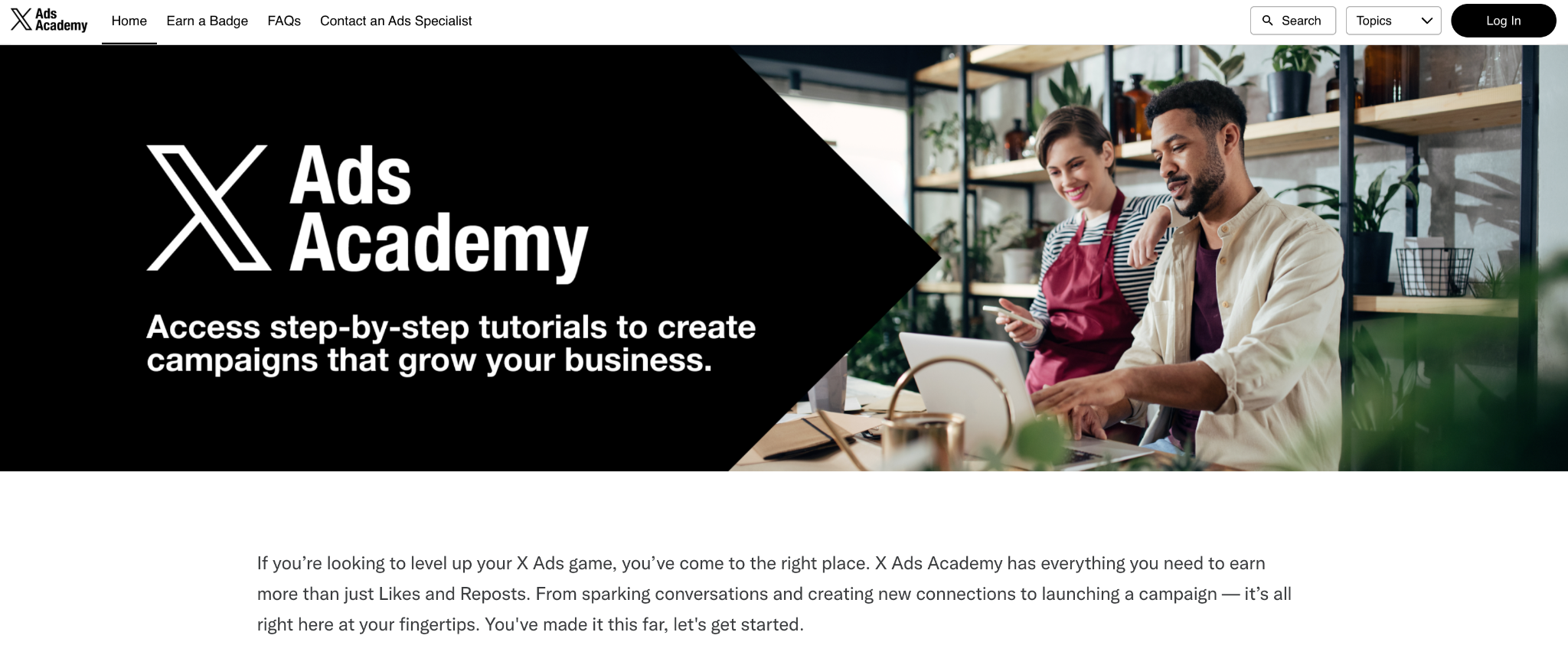
Companies like Meta Blueprint and X Ads Academy show how large organizations use customer education to support millions of users. For a fuller roundup of how companies structure these programs, see our customer education program examples.
Customer Education vs. Customer Success
Customer success and customer education are complementary functions, but they operate differently. Customer success is fundamentally a one-to-one relationship—a CSM works directly with individual accounts to drive adoption, resolve issues, and protect renewal. It's high-touch, relationship-driven, and difficult to scale without growing headcount proportionally.
Customer education is a one-to-many function. Instead of a CSM walking one customer through a feature, an education program teaches that same feature to thousands of customers simultaneously through courses, certifications, videos, and self-serve learning paths. Done well, customer education doesn't replace customer success. It makes customer success more effective by making sure customers arrive at every CSM interaction already equipped with foundational product knowledge.
The most mature organizations treat the two functions as a system. Customer success identifies where customers are struggling. Customer education builds the content that addresses those gaps at scale. According to Intellum's 2026 Education-Led Growth Report, 58.4% of education teams collaborate most closely with customer success, making it the second most common cross-functional partnership after customer support.
How Do You Launch a Customer Education Program?
Launching a customer education program takes more than buying software. A learning management system helps you scale, but your strategy drives real impact.
The Education-Led Growth (ELG) Framework gives you a clear way to build a program that improves product adoption, customer retention, and the overall customer experience. Instead of thinking in “steps,” ELG focuses on seven pillars that work together. You don’t have to perfect one before moving to the next; you can build them side by side.
Here’s how to launch your program using the ELG Framework:
1) Start with outcomes (your business goals).
First, decide what success looks like. If you don’t set clear business goals, you can’t prove the value of your program—or improve it.
Choose outcomes that matter to your company, such as:
- Higher product adoption
- Better customer retention
- Lower support costs
- Faster onboarding process
- Improved customer satisfaction
When you lead with outcomes, you create a program that supports the business—not just learning for learning’s sake.
2) Define your audience.
Next, identify who you need to educate. Most companies serve a wide customer base, and each group has different needs.
Ask questions like:
- Who are our main learner personas?
- What pain points do they face?
- What does “success” look like for each persona?
- Where do they struggle during onboarding?
When you understand your audience, you can create education content that feels helpful, not generic.
3) Choose the right initiatives.
Now decide what type of education program you need. Most companies start with onboarding because it drives early product adoption and helps customers get value faster.
Common customer education initiatives include:
- Onboarding courses and learning paths
- Product training and role-based learning
- Certifications
- Feature launch training
- Support team deflection programs that reduce tickets
- Learning that supports existing customers as your product grows
Your initiative should match your business goals and help customers solve real problems.
4) Plan your resources (including people and tools).
A customer education program needs more than content; it needs support.
That includes:
- People who can create and manage education content
- Subject matter experts
- A support team or customer success partners who can guide learning
- Tools that help you scale online learning
A learning management system plays a key role here. Your LMS helps you organize content, assign learning paths, track progress, and reach your customer base at scale.
5) Build a strong delivery strategy.
Once you have content, you need to deliver it in a way that works for real customers.
Use a mix of learning formats so customers can learn how they want:
- Short videos and quick guides
- Online learning courses and learning paths
- Live sessions for deeper support
- Certification programs for advanced learning
- Knowledge base links built into lessons
When you match delivery to real customer needs, you support faster product adoption and create a smoother customer experience.
6) Drive marketing and engagement.
Education that no one finds is education that doesn't work. A customer education marketing strategy is not a nice-to-have. It's the difference between a program that delivers ROI and one that sits unused. The most effective teams embed learning into the customer journey itself: onboarding emails, in-product prompts, customer success touchpoints, and product update communications all become entry points into the education program.
7) Measure and improve.
Finally, track what matters. Customer education works best when you measure results and improve your program over time.
Track metrics like:
- Product adoption and usage
- Customer satisfaction
- Customer retention
- Support costs and ticket reduction
- Engagement with education content
- Success rates during the onboarding process
When you measure outcomes, you can show how education supports business goals and where you should improve. For a deeper look at how to connect learning activity to business results, see our guide to learning efficacy and effectiveness.
Want to Learn More?
Intellum helps organizations build customer education programs that connect directly to adoption, retention, and expansion revenue. If you're ready to move beyond completion reports, see how it works. Book a Demo →
FAQs
What is customer education?
Customer education is the strategic process of teaching customers how to successfully use a product or service to achieve their desired outcomes. It includes onboarding, training, certifications, and ongoing resources that help customers succeed, which improves adoption, retention, and revenue.
Why is customer education important?
Customer education lowers support costs, speeds onboarding, and increases retention and expansion. Customers who understand a product use more of it and stay longer. It also creates a measurable link between learning and revenue.
How do you build a customer education program?
Start with the outcomes customers need to reach, map the knowledge gaps blocking them, then build onboarding, training, and certification to close those gaps. Measure against adoption and retention as well as course completion, and expand based on what moves those numbers.
How do you improve a customer education program?
Tie the program to business metrics like adoption, retention, and support deflection, then double down on the content that moves them. Use learning data to find where customers drop off and fix those points first.
What is a customer education program?
A customer education program is a formalized initiative that delivers structured learning to customers at scale through online courses, certifications, videos, learning paths, and self-serve content. The strongest programs define the business outcome first. In Intellum's 2026 Education-Led Growth Report, 81.6% of programs prioritize revenue as a core outcome.
What is the difference between customer education and customer success?
Customer success is one-to-one: a CSM works directly with an account to drive adoption and protect renewal. Customer education is one-to-many: courses, certifications, and self-serve content teach the same concept to thousands of customers at once. Success identifies where customers struggle, and education closes those gaps at scale.