On this page
Key takeaways
- Intellum’s 2023 survey found 60% of education professionals saw a mismatch between what customers were promised and what teams delivered.
- Forrester research commissioned by Intellum found formalized customer education drove 38.3% higher product adoption and 15.5% lower support costs.
- Intellum’s 2026 Education-Led Growth Report found 94.2% of education teams ran skills and enablement initiatives.
- Focus on customer expansion climbed 20 percentage points year over year in Intellum’s 2026 Education-Led Growth Report.
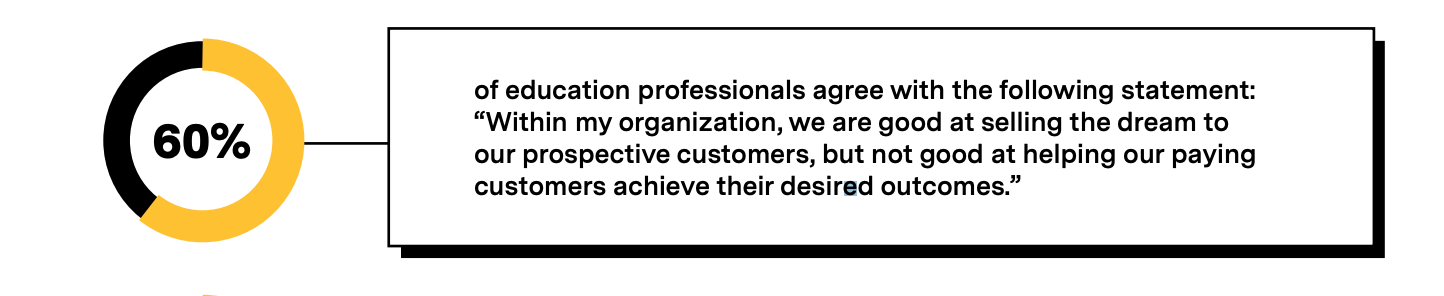
Our 2023 State of Education Initiative Ownership survey found that 60% of education professionals think there’s a mismatch between what customers are promised and the outcomes they’re able to deliver.
This mismatch creates a problem for both customers and businesses alike. When customers don’t find value in a product, they start looking for new solutions. So how can SaaS and other B2B companies ensure customers find value from their products and services? Customer enablement.
What is Customer Enablement?
Customer enablement is the strategic process of equipping customers with the tools, resources, education, and training they need to successfully achieve their desired outcomes with a product or service. Unlike sales enablement, which focuses on helping sellers close deals, customer enablement focuses on helping customers get lasting value after the sale.
This can look like templates, tools, and other resources. It can also include customer education and training.
For companies that rely on recurring revenue, customer enablement plays a key role in customer success.
What Are The Benefits of Customer Enablement?
Customer enablement programs improve the overall customer experience. As a result, effective customer enablement programs can provide immense benefits—both to you and your customers.
Customer enablement empowers customers to:
- Find value quickly
- Experience better outcomes
- Be more successful in their role and with your product
For your business, customer enablement increases:
- Customer loyalty
- Customer satisfaction
- Customer retention
- Customer lifetime value (CLTV or LTV)
- Referrals and advocacy
The data supports this. Forrester research commissioned by Intellum found that formalized customer education programs—the primary vehicle for customer enablement at scale—drive a 38.3% increase in product adoption, a 26.2% improvement in customer satisfaction, a 35% increase in average customer lifetime value, and a 15.5% decrease in customer support costs.
What Are Examples of Customer Enablement?
Customer enablement can take a lot of forms. To see it in practice, we talked with two customer enablement professionals to learn about what they’re doing.
Dan Park is a Customer Enablement Manager at Assignar. He shared that his team supports customers with product-focused webinars and help center articles. In addition, Assignar equips customers with broader industry-related resources.
Dan shared that his favorite assets to create are collaborative, cross-functional resources. These resources drive buy-in across teams and result in better, more thoughtful content.
We also spoke with Sana Farooq, Customer Education and Customer Success Consultant. Sana shared that she enjoys coordinating go-to-market (GTM) releases. These releases help customers get more value from their software. They also bring the company together around a shared goal.
Other customer enablement examples include the following:
- Customer enablement onboarding processes and checklists
- Customer success playbooks
- Customer quarterly business reviews
- Customer community events and podcasts
- Resources promoting additional features and services
Customer Enablement vs. Sales Enablement
Customer enablement is still a relatively new discipline — and often ill-defined. Understanding how it differs from sales enablement is a useful starting point.
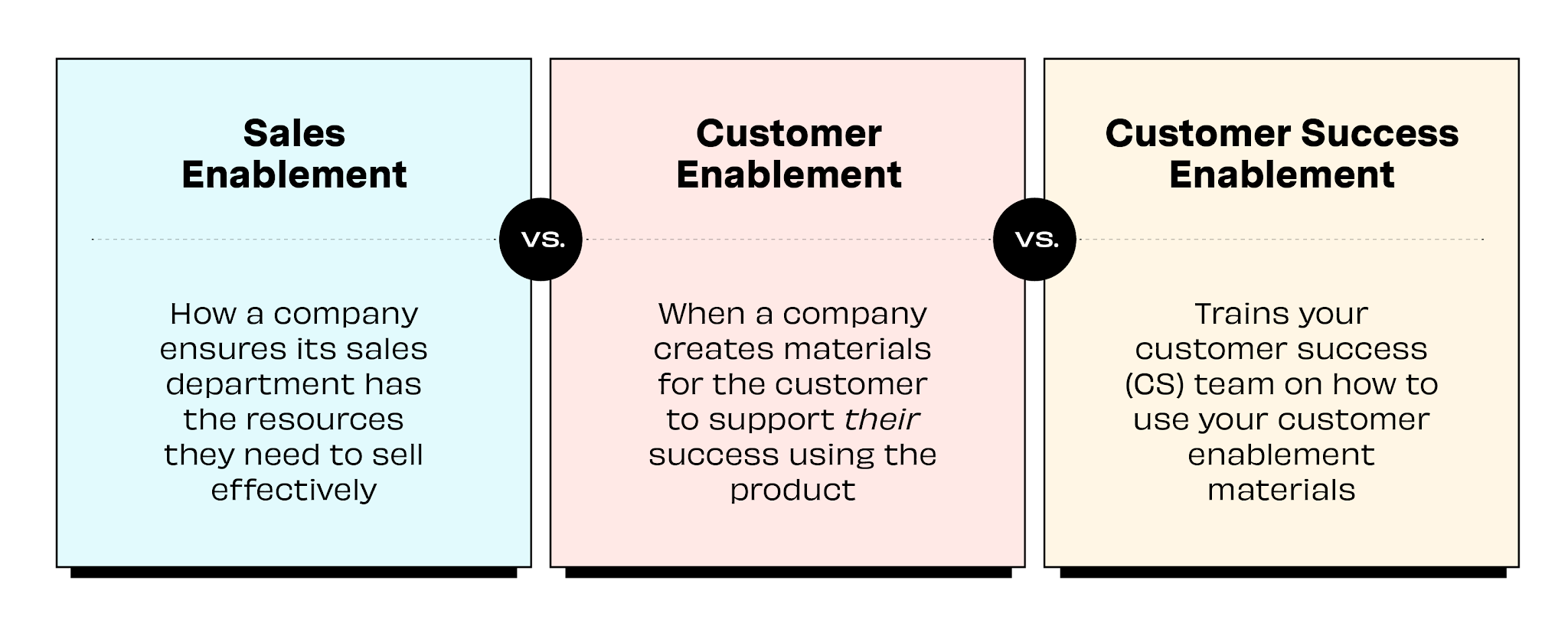
Sales enablement is how a company ensures its sales team has the resources they need to close deals effectively. The focus is internal—equipping sellers to win.
Customer enablement is how a company equips customers to succeed after the sale. The focus shifts from winning the customer to making them successful with what they bought. Customer enablement provides relevant resources throughout the customer lifecycle, helping customers grow, adopt more deeply, and get lasting value from the product.
How does customer education fit in? As customer education and enablement consultant Sana Farooq puts it, customer education "uses data to get ahead of where and how customers get stuck," making it one of the most proactive tools in a customer enablement strategy.
The good news is that these distinctions don't require separate resources for every audience. Many customer enablement materials are equally useful for prospects and sellers. A learning management system designed to deliver content to multiple audiences lets you build once and serve many—without rebuilding the same material for every function that needs it.
Customer Enablement vs. Customer Success
Customer success is a one-to-one function. A CSM works directly with individual accounts to drive adoption, resolve issues, and protect renewal. It is high-touch and relationship-driven. It is also difficult to scale without growing headcount in direct proportion to the customer base — which is why customer success alone is rarely enough.
Customer enablement is a one-to-many function. Instead of a CSM walking one customer through a feature or workflow, an enablement program delivers that same knowledge to thousands of customers simultaneously through courses, certifications, help content, and self-serve resources. The same outcome. A fraction of the cost per customer.
The distinction matters because organizations often invest heavily in customer success headcount before asking whether education could solve the same problem at scale. In many cases, it can.
Customer Enablement vs. Customer Education
Customer enablement is the broader strategic function—everything a company does to help customers achieve outcomes after the sale. Onboarding checklists, success playbooks, support resources, community, training. The full system of tools, content, and processes that sits between the purchase and the result.
Customer education is the execution layer that makes that system work at scale. Where customer enablement defines what customers need to know and do, customer education delivers the structured learning that actually changes behavior, such as courses, certifications, learning paths, on-demand training built around outcomes rather than features.
The organizations that get this wrong invest in enablement resources without the educational infrastructure to deliver them consistently. A help article is not a curriculum. A product walkthrough is not a learning path. Without structured education behind it, customer enablement remains a collection of assets rather than a program that produces measurable results.
According to Intellum's 2026 Education-Led Growth Report, 94.2% of education teams now run skills and enablement initiatives—the most common education use case by a wide margin. The most effective of those programs are backed by a dedicated customer education platform that organizes content, tracks learner progress, and connects education activity to the business outcomes the program was built to drive.
Get Started with Customer Enablement
Customer enablement is no longer a nice-to-have. According to Intellum's 2026 Education-Led Growth Report, focus on customer expansion climbed 20 percentage points year over year, reflecting how organizations are beginning to treat education and enablement not just as retention tools, but as direct drivers of expansion revenue. If you're looking to get ahead of that shift, here are four strategies to start enabling your customers effectively.
1. Educate customers
If onboarding checklists are the roadmap to help customers see what needs to be done and when, then customer education is the vehicle that gets them from one destination to the next.
Customer education content can take a number of forms, including:
- Videos
- Courses
- Certifications
- Training
- Help articles
- Tutorials
Comprehensive education helps prevent customer challenges, reduce reliance on customer support, and assist customers in reaching their goals.
2. Provide outstanding support
While customer education helps prevent many issues, some customers still require direct support.
If your company provides outstanding customer support, you’ll retain customers longer—but they aren’t the only ones who benefit.
Customer support requests can inform education content. Take a look at your help tickets to uncover where customers get stuck—so you can be proactive in addressing their needs.
3. Create community
Customer communities enable customers to talk things through, learn from peers, and solidify learning in ways that give life to the concepts you taught them. This process frees up your customer support team to handle the most complex issues—and allows your customer education team to focus on content that serves the majority of use cases.
Communities can also give rise to new enablement materials. Think about resources, tips, and templates customers share. Often, what's helpful for one customer is helpful for many. You can pull from these resources to create additional enablement materials to serve your customer base.
By offering customers this opportunity for social learning, your company can improve learner retention and outcomes as customers observe peer experiences, collaborate, and get feedback.
4. Collect customer feedback and improve
Keep in mind: Your customer enablement program is never "finished!" You'll continue to review and refine your resources. Over time, you may even sunset some resources that are no longer useful or relevant.
The best way to iterate is by collecting and acting on customer feedback. This feedback allows you to understand customer needs. And, in turn, those needs inform and refine your strategies and materials.
Where can you find customer feedback? Customers are already sharing their experiences through communities, Net Promoter Score (NPS) surveys, and support tickets. Use this readily accessible data to make improvements and address knowledge gaps.
4 Best Practices From Customer Enablement Professionals
Ready to tackle customer enablement? Check out these tips and best practices from customer enablement professionals:
1. Don't recreate the wheel.
Sana recommends cataloging and leveraging internal resources. This includes knowledge base articles, courses, and onboarding guides. It can also mean interviewing internal employees to capture their knowledge and process.
Repurposed materials can serve both external customers and employees alike. “There's valuable knowledge everywhere. You just have to be proactive and resourceful in finding it,” Sana shared.
2. Look to internal subject matter experts.
It's likely there are people in your company who are already working on customer enablement. Dan recommends finding those people—even if they don't have the enablement title.
“External inspiration is great for frameworks, ideas, and best practices. Internal inspiration helps to apply those to your customers,” Dan shared.
You might find conversations with solutions engineering, sales, support, and customer success to be beneficial.
3. Keep the customer in focus.
It’s easy to get bogged down in the details. But, often, these details matter more to you than the customer, Dan remarked. His advice? “It’s helpful to schedule regular check-ins to step back, get feedback, and make adjustments.”
4. Don’t strive for immediate perfection.
The first version of a training program or resource won’t be perfect, but don’t let that hold you back.
“Try things out, learn from feedback, and iterate. It’s said that ‘good is the enemy of great.’ But rarely is great achieved without good." - Dan Park
Ready to Build?
Intellum helps organizations build customer enablement programs that connect education directly to product adoption, retention, and expansion revenue. If you're ready to move beyond ad hoc resources and build a program the business can measure, see how it works. Book a Demo →
FAQs
What is customer enablement?
Customer enablement is the strategic process of equipping customers with the tools, resources, education, and training they need to achieve their desired outcomes with a product. Unlike sales enablement, which helps sellers close deals, customer enablement focuses on helping customers get lasting value after the sale.
What are the benefits of customer enablement?
Customer enablement helps customers find value quickly and succeed in their roles. For the business, it increases loyalty, satisfaction, retention, lifetime value, and advocacy. Forrester research commissioned by Intellum found formalized customer education drives a 38.3% increase in product adoption and a 15.5% decrease in support costs.
How is customer enablement different from customer education?
Customer enablement is the broader function covering everything that helps customers achieve outcomes after the sale, including onboarding checklists, playbooks, support resources, and community. Customer education is the execution layer that delivers structured learning, such as courses and certifications, which actually changes behavior at scale.
How do you get started with customer enablement?
The post outlines four strategies: educate customers with content like videos, courses, and certifications; provide outstanding support and use tickets to inform content; create community for peer and social learning; and collect customer feedback to continuously refine your resources.